Every organization deploying AI agents is somewhere on a maturity curve. The problem is that most don't know where they are, which means they can't plan where they need to be.
Maturity models are familiar territory for security and compliance leaders — you've worked with CMMI, NIST CSF tiers, CIS implementation groups, and SOC 2 readiness assessments. They provide a common language for understanding current state, defining target state, and measuring progress.
No equivalent exists for agent governance. Until now.
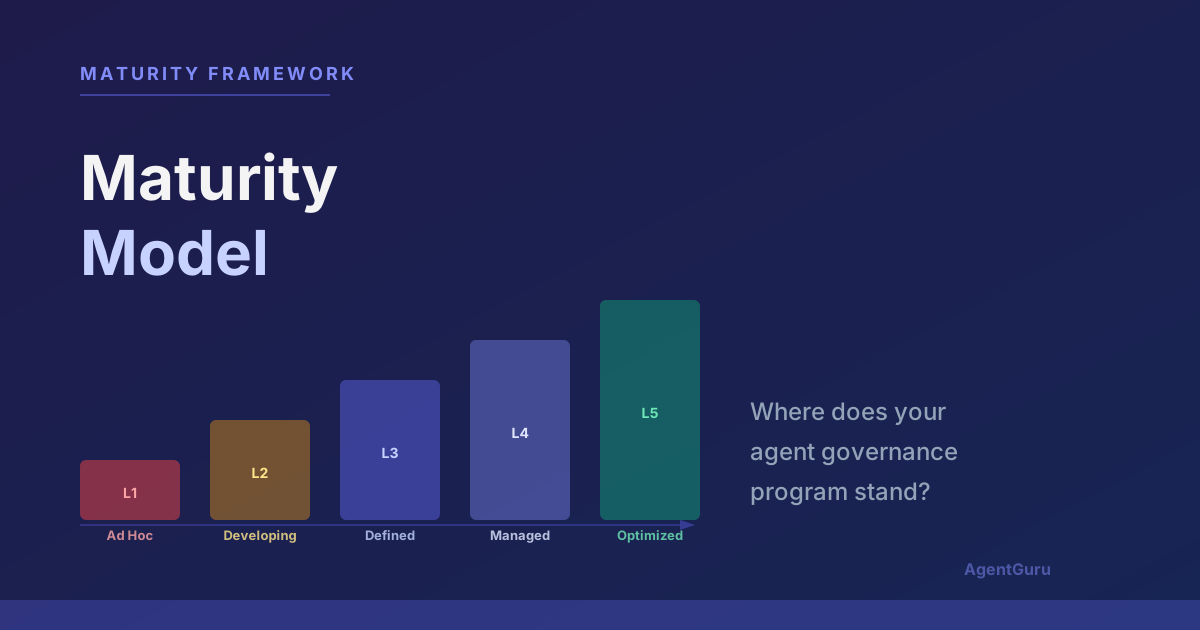
The Agent Governance Maturity Model (AGMM) defines five levels that describe an organization's capability to govern AI agents responsibly and defensibly. Each level builds on the previous one. The goal isn't to reach Level 5 for every agent — it's to operate at the appropriate maturity level for your agent portfolio's risk profile.
Level 1: Unaware
Characteristic: The organization deploys AI agents without recognizing them as a distinct governance category.
At this level, agents exist in the environment, but nobody has framed them as entities requiring specific governance. There is no agent inventory. No policies address agents specifically. Agents are treated the same as any other software integration — if they're governed at all, it's through general IT change management or application security processes that weren't designed for autonomous systems.
What this looks like in practice: A developer deploys an agent using their personal API key. The agent accesses a production database through a connection string stored in the application configuration. Nobody outside the development team knows the agent exists. There's no logging beyond application-level error handling. When the developer leaves the company, the agent keeps running.
Typical characteristics:
- No agent inventory — nobody knows how many agents are running or where
- No agent-specific policies — agents are governed (if at all) by general IT policies
- No designated ownership — nobody is accountable for agent behavior
- No monitoring beyond uptime — the agent either works or doesn't
- No decommissioning process — agents accumulate indefinitely
Risk posture: The organization cannot answer basic questions about its agent usage. It cannot defend its governance posture to a regulator, auditor, or board member. Exposure to agent-related incidents is unknown and unmanaged.
Most common among: Early-stage companies, organizations where AI adoption is bottom-up and grassroots, and enterprises where the security team hasn't yet scoped agents as a distinct risk category.
Level 2: Reactive
Characteristic: The organization recognizes agents as a governance challenge, typically after an incident or near-miss, and begins ad hoc responses.
The transition from Level 1 to Level 2 is almost always triggered by an event — a customer complaint traced to an agent, a data access anomaly identified during an audit, a board member's question that nobody could answer, or a news story about an agent-related incident at another company.
At this level, governance is reactive and project-specific. The team that experienced the incident implements controls for their agents, but there's no organization-wide framework. Knowledge is concentrated in the teams that have been burned.
What this looks like in practice: After a customer service agent provides incorrect refund information to 200 customers, the customer service team implements output review and adds logging. Meanwhile, the finance team's agent still runs with no monitoring, and the engineering team's agents have no documentation.
Typical characteristics:
- Partial agent inventory — some teams have documented their agents, most haven't
- Ad hoc policies — controls exist for specific agents that caused problems
- Incident-driven governance — changes happen after failures, not before
- Inconsistent monitoring — some agents are well-monitored, most are not
- No standard process — each team governs agents differently
Risk posture: The organization has some awareness of agent risk but cannot demonstrate systematic governance. If an incident occurs in an area that hasn't been through the pain of a previous failure, the organization is back to Level 1 for that specific agent.
Level 3: Structured
Characteristic: The organization has established formal agent governance policies and processes, but implementation is still maturing.
Level 3 represents the shift from reactive to proactive governance. The organization has recognized that agents require specific, organization-wide governance and has put the foundational elements in place.
What this looks like in practice: A CISO sponsors an agent governance initiative. An agent inventory is conducted across the organization. Policies are drafted and published — acceptable use, data access, incident response. An agent onboarding review process is established. A governance committee is formed, even if it only meets quarterly.
Typical characteristics:
- Complete agent inventory maintained and updated on a defined cadence
- Published agent governance policies — acceptable use, data access, incident response
- Standard onboarding process for new agents with security review
- Consistent logging and monitoring requirements across all agents
- Designated ownership — every agent has an identified owner
- Agent risk assessment conducted at deployment using a defined methodology
- Governance committee with regular review cadence
- Decommissioning process documented and followed
Risk posture: The organization can demonstrate to regulators, auditors, and the board that it has a governance program for AI agents. There are documented policies, a review process, and evidence of implementation. Gaps exist — policies may not be fully enforced, monitoring may not cover all agents, and incident response hasn't been tested — but the framework is in place.
This is the minimum viable maturity level for organizations deploying agents in regulated industries or handling sensitive data. Getting to Level 3 should be the immediate goal for any enterprise serious about agent governance.
Level 4: Managed
Characteristic: Agent governance is embedded in operational processes, measured with metrics, and continuously improved.
At Level 4, governance isn't just a policy framework — it's an operational capability. The organization doesn't just have policies; it has evidence that they're being followed. It doesn't just have monitoring; it has metrics that track governance effectiveness over time.
What this looks like in practice: Agent governance metrics are reported to the CISO monthly and to the board quarterly. Every agent in the inventory has a current risk score. Policy compliance is measured — not just "does the policy exist" but "is every agent operating within policy." Incident response playbooks have been tested through tabletop exercises. The governance program is budgeted and staffed.
Typical characteristics:
- Governance metrics tracked and reported — compliance rates, risk score distribution, incident frequency, time-to-remediation
- Automated policy enforcement — guardrails, permission controls, and monitoring implemented through technical controls, not just written policies
- Regular testing — incident response tabletops, permission audits, guardrail effectiveness testing
- Continuous improvement — governance practices updated based on incident learnings, new threat intelligence, and regulatory changes
- Cross-functional integration — agent governance is integrated with broader IT governance, risk management, and compliance programs
- Training program — staff involved in agent deployment and management receive governance training
Risk posture: The organization can demonstrate not just that it has policies, but that they're effective. Governance is measurable, evidence-based, and integrated into operations. The organization can withstand regulatory scrutiny, customer due diligence, and board challenge with quantitative evidence of governance effectiveness.
Level 5: Optimized
Characteristic: Agent governance is a strategic capability that enables faster, safer agent deployment and creates competitive advantage.
Level 5 represents governance as an enabler rather than a constraint. The organization has built enough governance capability that it can deploy agents faster and more confidently because governance is built into the process, not bolted on afterward.
What this looks like in practice: New agents go from concept to governed production deployment in days, not months, because the governance process is efficient and well-understood. The organization has contributed to industry standards for agent governance. The governance program generates intelligence that informs AI strategy — which agents are delivering value, which are creating risk, where the organization should invest or divest.
Typical characteristics:
- Governance-by-design — governance requirements are integrated into agent development processes from the start
- Automated governance pipeline — risk assessment, permission provisioning, monitoring setup, and documentation generated automatically as part of agent deployment
- Industry leadership — contributing to standards bodies, publishing research, sharing (anonymized) governance practices
- Predictive governance — using data from the governance program to anticipate risks before they materialize
- Governance as competitive advantage — faster compliance clearance, stronger customer trust, better regulatory relationships because of demonstrated maturity
Risk posture: The organization's agent governance is a demonstrable strength. It accelerates business goals rather than constraining them. It provides board-level confidence in the organization's AI strategy. It serves as a differentiation point in customer and partner relationships.
Assessing Your Current Level
Be honest. Most organizations today are at Level 1 or Level 2. That's not a criticism — agent governance is a new discipline, and the frameworks and tools are still emerging.
The assessment isn't about achieving a high score — it's about understanding the gap between where you are and where you need to be given your agent portfolio's risk profile.
If your agents are all low-risk (Tier 1-2 on the risk scoring methodology): Level 3 is a reasonable target.
If you have agents in regulated contexts or handling sensitive data (Tier 3-4): Level 4 is the target, and Level 3 is the minimum acceptable state.
If you're a platform provider, an agent vendor, or an organization where agent-driven processes are core to the business: Level 5 is the aspiration.
Getting From Here to There
The path from your current level to your target level is a governance roadmap. Each level transition requires specific investments.
Level 1 → 2: Conduct an agent inventory. Identify your highest-risk agents. Implement basic controls for those specific agents. This is a weeks-long effort, not a months-long one.
Level 2 → 3: Formalize your governance program. Draft organization-wide policies. Establish an onboarding process. Implement the risk assessment methodology. Assign ownership. This takes 2-4 months depending on organizational size and complexity.
Level 3 → 4: Invest in automation, measurement, and testing. Implement technical controls that enforce policies automatically. Build governance dashboards. Test your incident response. This takes 6-12 months and requires dedicated resources.
Level 4 → 5: Integrate governance into the development lifecycle. Build automation into the deployment pipeline. Contribute to industry standards. Use governance data to inform strategy. This is an ongoing capability investment.
The governance toolkit, certification, and assessment practice I'm building at AgentGuru are designed to accelerate each of these transitions — providing the templates, frameworks, and expertise to move faster than building from scratch.
Score your organization's maturity in 10 minutes. Download the free 25-point Agent Governance Checklist at agentguru.co — the questions map directly to this maturity model.
Ready to level up? The Agent Governance Toolkit gives you the policies, frameworks, and templates to move from Level 1-2 to Level 3 in weeks instead of months. Get the toolkit →
Ritesh Vajariya is the CEO of AI Guru and founder of AgentGuru. Previously AWS Principal ($700M+ AI revenue), BloombergGPT Architect, and Cerebras Global Strategy Lead. He has trained 35,000+ professionals and built products serving 50,000+ users.
Ready to govern your AI agents?
20+ ready-to-deploy policy templates, risk frameworks, and governance playbooks. Deploy in hours, not months.
Get the Toolkit →