Your application monitoring stack is mature. You track uptime, latency, error rates, and throughput. Your security monitoring covers network anomalies, authentication events, and data access patterns. Your APM tools trace requests from frontend to backend and flag performance regressions.
None of this tells you what your AI agents are actually doing.
Agent observability is a fundamentally different challenge from application monitoring. An agent can be "up" — responding to requests, meeting latency SLAs, returning zero errors — while simultaneously producing incorrect outputs, accessing data outside its intended scope, or taking actions that violate your policies. Traditional monitoring instruments can't detect these failures because they operate at the infrastructure layer, not the semantic layer.
What follows is a practical framework for agent observability that covers what to log, what to monitor continuously, and what conditions should trigger alerts and human intervention.
The Three Layers of Agent Observability
Layer 1: Infrastructure Observability (What You Already Have)
This layer covers the operational health of the agent as a software system. Most organizations already have this through existing monitoring tools.
What to log: Process health metrics (CPU, memory, network), API response times, error rates, queue depths, connection pool utilization, model API latency and availability.
What to monitor: Uptime and availability SLAs, response time percentiles (p50, p95, p99), error rate trends, resource utilization trends, dependency health (model APIs, databases, external services).
What to alert on: Agent process crashes, model API timeouts exceeding threshold, error rate spikes above baseline, resource exhaustion (memory leaks, connection pool exhaustion), dependency failures.
This layer is necessary but not sufficient. You can have green lights across every infrastructure metric while your agent is confidently giving customers wrong information.
Layer 2: Behavioral Observability (What Most Organizations Are Missing)
This layer monitors what the agent is doing — the actions it takes, the data it accesses, and the patterns of its behavior over time. This is where the gap exists in most enterprises.
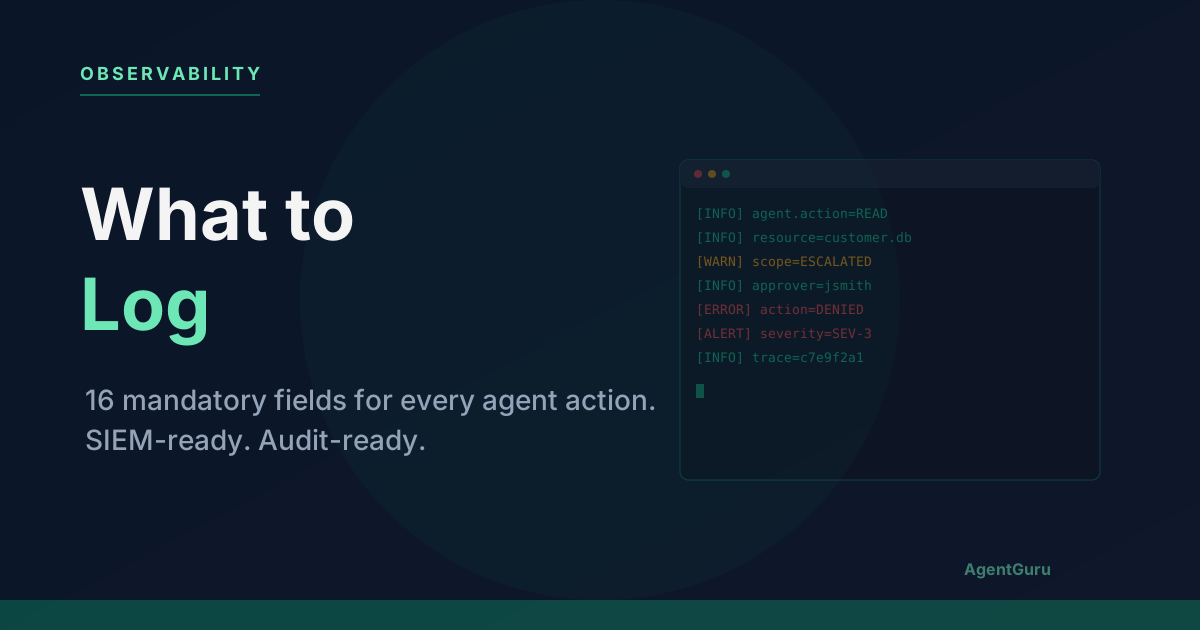
What to log — for every agent interaction:
Input logging. The full input the agent received, including the user's message, any system context injected, and any retrieved documents or data used for context. Redact or tokenize sensitive data (PII, credentials) before logging, but retain enough structure to reconstruct what the agent was working with.
Reasoning trace logging. If the agent framework exposes chain-of-thought, tool selection, or planning steps, log them. This is your forensic record for understanding why the agent did what it did. Many frameworks (LangChain, CrewAI, AutoGen) support callback-based tracing that captures these intermediate steps.
Tool invocation logging. Every tool call the agent makes — which tool, what parameters, what the tool returned. This is critical because tool invocations are where agents interact with real systems. Log the full request and response for each tool call, with sensitive data redacted.
Data access logging. Every database query, API call, file read, or data retrieval the agent performs. Include the query or request parameters (not just "accessed customer database" but "queried customers table for customer_id=12345, returned fields: name, email, order_history").
Output logging. The final output the agent produced — the response to the user, the action it took, the record it created or modified. Log both the output content and the delivery mechanism (returned to user, written to database, sent via email).
Guardrail event logging. Every time a guardrail is triggered — content filter activated, permission check failed, rate limit hit, escalation to human initiated. These events are early warning signals and compliance evidence.
Correlation identifiers. Every log entry should include a session or conversation ID that links all events in a single agent interaction, an agent identity that uniquely identifies which agent produced the event, and a timestamp with sufficient precision for sequencing.
What to monitor continuously:
Action distribution. Track the distribution of actions your agent takes over time. If an agent that normally performs 80% reads and 20% writes suddenly shifts to 60/40, something changed. Monitor the relative frequency of different action types and flag deviations from the baseline.
Data access patterns. Monitor which data sources the agent accesses, how frequently, and whether the access patterns match its documented scope. An agent that starts querying tables it doesn't normally touch, or accessing records in bulk rather than individually, warrants investigation.
Output characteristics. Monitor measurable properties of agent outputs — length, sentiment, confidence scores (if available), use of specific language patterns. Significant shifts in output characteristics often precede visible quality degradation.
Escalation rate. Track how often the agent escalates to a human or triggers a guardrail. A sudden increase in escalation rate suggests the agent is encountering inputs or situations outside its comfort zone. A sudden decrease might suggest guardrails are being bypassed.
Latency by step. Monitor not just total response time but time spent in each phase — retrieval, reasoning, tool invocation, output generation. Changes in the latency profile can indicate model degradation, data quality issues, or infrastructure problems before they affect output quality.
What to alert on:
Action scope violations. The agent attempts an action outside its authorized scope — accessing an unauthorized data source, calling a prohibited API, attempting to take an action above its permission tier. Immediate alert, automatic block.
Volume anomalies. The agent performs significantly more actions in a time period than its historical baseline. A customer service agent that normally handles 200 interactions per day suddenly processing 2,000 could indicate a runaway loop, a misconfiguration, or adversarial exploitation.
Output quality signals. If you have automated quality checks — factuality verification, policy compliance checks, sentiment analysis — alert when quality metrics drop below threshold. Even partial coverage is valuable.
Error pattern changes. A shift in the types or frequency of errors the agent produces. New error types are especially significant — they may indicate the agent encountering novel situations it wasn't designed to handle.
Guardrail fatigue. A sustained increase in guardrail triggers without corresponding operational changes. This may indicate that the agent's operating environment is shifting beyond its design parameters, or that adversarial users have found a pattern that repeatedly triggers edge cases.
Layer 3: Outcome Observability (The Hardest and Most Important)
This layer monitors the real-world consequences of agent actions. It's the hardest to implement because it requires connecting agent behavior to business outcomes, but it's the layer that ultimately determines whether your agents are helping or harming.
What to log:
Decision outcomes. When an agent makes a decision that has a verifiable outcome — approved a claim that turned out to be fraudulent, recommended a product that was returned, provided information that a customer later disputed — log the connection between the agent's action and the downstream outcome.
Customer feedback signals. Track customer satisfaction scores, complaint rates, and escalation requests specifically for agent-handled interactions versus human-handled interactions. Divergence is a leading indicator of agent quality issues.
Business metric attribution. Connect agent actions to business metrics where possible. Refund rates for agent-processed claims. Conversion rates for agent-qualified leads. Resolution rates for agent-handled support tickets. These metrics provide ground truth for whether the agent is performing as intended.
What to monitor:
Outcome drift. Track outcome metrics over time and flag gradual deterioration. Agent quality often degrades slowly — a model update that slightly reduces accuracy, a data source that becomes stale, an edge case that becomes more common. Outcome monitoring catches these slow degradations that behavioral monitoring might miss.
Comparative performance. Where possible, compare agent outcomes to human outcomes for similar tasks. If the agent's refund approval rate diverges significantly from the human baseline, investigate. Divergence in either direction is informative — agents that are significantly more permissive or significantly more restrictive than humans both warrant review.
What to alert on:
Outcome reversals above threshold. If more than a defined percentage of agent decisions are being reversed by humans, overridden by downstream processes, or resulting in customer complaints, alert immediately. The threshold depends on the domain — a 2% reversal rate might be acceptable for low-stakes decisions but unacceptable for financial transactions.
Customer escalation spikes. A sudden increase in customers requesting to speak with a human after interacting with an agent. This often indicates that the agent is producing unsatisfying or incorrect responses that aren't caught by other monitoring layers.
Implementation Priorities
You can't build all three layers at once. Prioritize based on agent risk tier.
For all agents (minimum viable observability): Infrastructure monitoring plus input/output logging with correlation IDs. This gives you the ability to reconstruct what happened during any interaction.
For medium-risk agents (Tier 2-3): Add behavioral monitoring with baseline profiling, tool invocation logging, and automated alerts for scope violations and volume anomalies.
For high-risk agents (Tier 4): Full three-layer observability including real-time output quality monitoring, guardrail event analysis, outcome tracking, and comparative performance benchmarking.
The Compliance Dimension
Agent observability isn't just an operational concern — it's increasingly a compliance requirement. The EU AI Act mandates logging and monitoring for high-risk AI systems. Sector regulators in financial services and healthcare expect audit trails for automated decision-making. And in any potential litigation involving agent behavior, your ability to produce a forensic record of what the agent did and why will be central to your defense.
Build your observability infrastructure with the assumption that audit logs will eventually be reviewed by someone outside your organization — a regulator, an auditor, or a legal team. That changes what you log, how long you retain it, and how you ensure its integrity.
The Agent Governance Toolkit includes a complete observability and audit logging standard with implementation specifications, retention requirements, and compliance mapping across major regulatory frameworks. Get the toolkit at agentguru.co →
Ritesh Vajariya is the CEO of AI Guru and founder of AgentGuru. Previously AWS Principal ($700M+ AI revenue), BloombergGPT Architect, and Cerebras Global Strategy Lead. He has trained 35,000+ professionals and built products serving 50,000+ users.
Ready to govern your AI agents?
20+ ready-to-deploy policy templates, risk frameworks, and governance playbooks. Deploy in hours, not months.
Get the Toolkit →